
Testing of concrete by impact loads
 17 November 2025
 166
166
The next stage of experimental work on testing prototypes of concrete, polymer concrete, polymer cement fiber concrete and concrete polymers was carried out at the "A.S. Akhmetov Nanoengineering Research Methods Laboratory". The experiments were conducted as part of the program "BR24992867 - Development of resource-saving technologies for the development and management of water management and processing industry in Kazakhstan, creation of an innovative engineering center." Research and development includes the following tasks of the program's calendar plan:
1) 2.5.1 Investigation of the quality of new building materials, geometric dimensions and shapes of structures;
2) 2.5.2 Investigation of the structure and physico-mechanical and operational properties of hydraulic polymer concrete;
3) 2.5.3 Development of technological parameters for obtaining polymer concrete.
The tests were conducted by Senior researchers, PhD Atenov Y.I. and Master Shanshabaev N.A. under the guidance of Leading researcher, Doctor of Technical Scienses Bekbasarov I.I.
The concrete prototypes were produced at the first stages of the research. For their testing under the action of repeatedly repeated dynamic (shock) loads, a special impact-type laboratory mechanical installation was developed and constructed (Fig. 1).
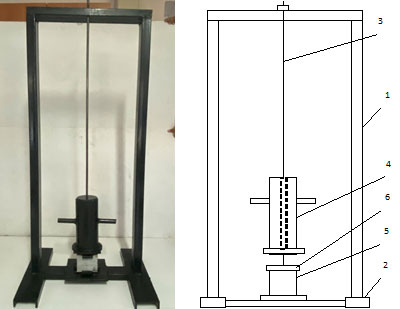
1 - U-shaped supporting frame; 2 - support part; 3 - guide rod; 4 – impactor; 5 - test sample; 6 - support plates.
Figure 1 – Laboratory installation for impact testing
The results of testing concrete samples for impact loads are shown in diagrams in Figure 2. The standard deviations of the data on the average impact strength of samples at different periods of water saturation are shown in Figure 3. Their maximum values are not higher than 0.45 kJ, which indicates the reliability of the average values of energy costs for destruction. Fragments of tests and destruction of samples are shown in Figure 4.
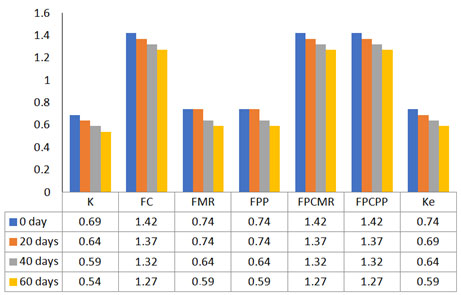
Figure 2 – Average total energy for initiation of sample damage, kJ
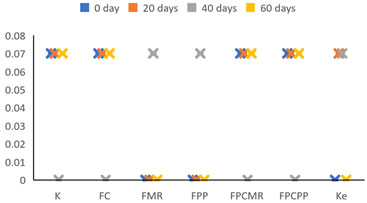
Figure 3 – Standard deviations of the data on the average impact strength of samples at different periods of water saturation at the stage of damage initiation
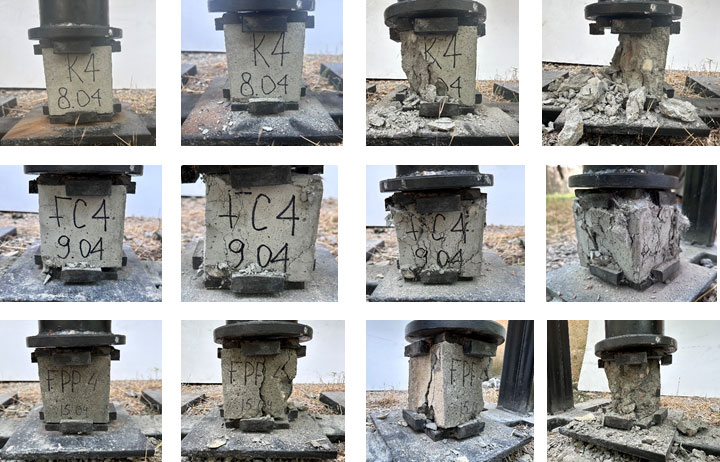
Figure 4 – Fragments of testing and destruction of concrete samples by impact loads: a) Initial state; b) The stage of damage initiation; c) The stage of progressive destruction; d) The stage of complete destruction.
The results of determining the values of the relative energy intensity coefficient at the stage of damage initiation of concrete samples SE, calculated by formula (1) are presented in Table 1 and Figure 5.
|
Sg =B o n / B k n, |
(1) |
where: – impact energy for the test sample, kJ; – impact energy for the control sample, kJ; n – sample type.
Table 1 - Values of the relative energy intensity coefficient at the stage of damage initiation of concrete samples
|
Type of concrete |
Values of the coefficient of relative energy intensity at the stage of damage initiation of samples during water saturation at the |
||
|
20 days |
40 days |
60 days |
|
|
Control concrete |
0.93 |
0.85 |
0.78 |
|
Polypropylene fiber concrete |
0.96 |
0.93 |
0.89 |
|
Polymer cement concrete |
1.0 |
0.86 |
0.80 |
|
Polymer cement concrete |
1.0 |
0.86 |
0.80 |
|
Polymer cement fiber concrete |
0.96 |
0.93 |
0.89 |
|
Polymer cement fiber concrete |
0.96 |
0.93 |
0.89 |
|
Concrete polymer |
0.93 |
0.86 |
0.80 |
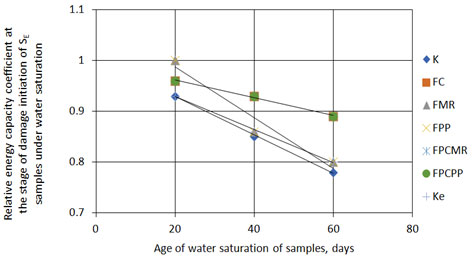
Fig. 5 - Dependence of the coefficient of relative energy intensity at the stage of damage initiation of concrete samples on the duration of water saturation
The graphs shown in Fig. 6 are described by the following linear function
|
(2) |
where: k and o are the parameters taken from Table 11 depending on the type of concrete; t is the duration of water saturation of concrete, days.
Table 2 - Values of parameters k and o in formula (2).
|
Designation of samples |
Parameter values |
Approximation index R2 |
|
|
k |
o |
||
| K |
0.0037 |
1.0033 |
0.9985 |
| FC |
0.0018 |
0.9967 |
0.9932 |
| FMR |
0.005 |
1.0867 |
0.9494 |
| FPP |
0.005 |
1.0867 |
0.9494 |
| FPCMR |
0.0018 |
0.9967 |
0.9932 |
| FPCPP |
0.0018 |
0.9967 |
0.9932 |
| Ke |
0.0032 |
0.9933 |
0.998 |
The analysis of the test results at the stage of damage initiation of concrete samples, presented in Fig. 11 and Table 10, allows us to draw the following conclusions:
- the resistance to destruction under impact loads of polymer concrete is, on average, 1.07-2.35 times higher than that of the control concrete;
- the impact resistance of polymer concrete treated with polyester resin PN-609-21M (Ke), as well as polymer cement concrete with additives Polyplast SP-1 (FPP) and MasterRHEOBUILD 1033 (FMR) is 1.07-1.09 times higher compared to control concrete (K);
- polymer-cement fiber-reinforced concretes with additives MasterRHEOBUILD 1033 (FPCMR) and Polyplast SP-1 (FPCPP), as well as polypropylene fiber-reinforced concretes (FC) are characterized by 2.06-2.35 times higher impact resistance compared to control concrete samples (K);
- with an increase in the water saturation period of the samples from 20, 40, and 60 days, a decrease in the impact resistance of the samples by 4-7%, 7-15%, and 11-22%, respectively;
- with a water saturation period of 20, 40, and 60 days, the impact strength decreased: for samples FC, FPCMR and FPCPP– by 4, 7, and 11%, respectively; for Kesamples – by 7, 14, and 20%; and for samples FMR and FPP, a decrease in the desired characteristic of 14 and 20% was observed at 40 and 60 days of water saturation of the samples.